I. HISTORY BEHIND TEE CREW COMPLEMENT ISSUE
How did the crew complement problem arise? I. TIlE 80,000 POUND RULE
In 1919, the world’s first regular scheduled passenger service between London and Paris commenced operation. It was only 15 years before in 1903 that the Wright Brothers succeeded in flying their first power driven airplane, “Flyer.” At that time, the flight was conducted by one pilot. In 1931, the first regulation concerning crew complement was established in the United States. It required a co-pilot to be aboard transport airplanes with a gross weight of over 15,000 pounds or over 15 passengers.
By 1933, as the two man crew complement became common with the introduction of the B-247 and DC-2, it became customary to have on board maintenance crew for inflight repairs and maintenance at airports in remote locations.
In 1945, the CAB of the United States required flight engineers to be on board aircraft designed for regular international scheduled flights and on aircraft recognized to be designed in such a way as to necessitate their presence on board. Thus it became obligatory for flight engineers to be on board a certain number of airplanes.
In 1947, while many two and three man aircraft were flying, the two-man DC-6 was involved in serveral consecutive accidents. People became Aware of the importance of having flight engineers on board due to the size and complexity of the aircraft, the increase in traffic volume and the problems of trams-oceanic flight. In 1948, the US CAB established a rule that required aircraft with a maximum takeoff weight of 80,000 pounds or more to include a night engineer in its crew. This was what became to be known as the “80,000 pound rule.” Changes in design were made in the DC-6 due to this rule, making it a three man aircraft with the B-707, DC-8 and others following suit.
However, in the 1960s, Douglas decided to develop the DC-9 with two man crew complement in order to e:pand its market and filed a complaint to the FAA concerning the “80,000 pound rule” which was blocking its development. The FAA considered the complaint and revised the rule to read that the decision of whether to use the three man complement would rest on the evaluation of workload of the particular aircraft. The”80,000 pound rule” was thus abandoned in 1965. BAC-111 and B-737 that followed acquired their airworthiness certifications under the new rule.
What is meant by evaluation of workload on an aircraft?
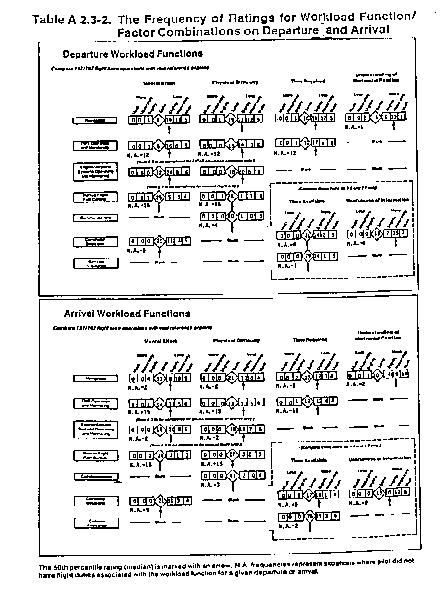
There are two methods of evaluating workload. One is estimating the pilots, hand and eye movement between takeoff and landing in relation to time.
The other is evaluating the pilots’impression after flight through questionaires.
Boeing stresses that decrease in the number of lights, instruments and switches would result in the decrease of the workload and it is working towards the implementation of the two man crew complement through this method.
Airbus says the total number of lights, instruments and switches does not change in the determination of whether the aircraft be two man or three man. It intends to implement the two man crew complement without the decrease in instruments.
For Example, Comparison in ELEC SMOKE OR FIRE CHECK LIST of the conventional B747 with the 400 series.
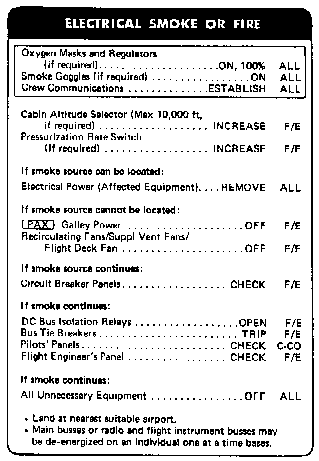
Procedure : FIRE OR SMOKE- ELECTRICAL
Rev.Date : 04-01-87
Condition : A concentration of smoke is identifiable.
If smoke source can be determined :
ELECTRICAL POWER (affected equipment)………… REMOVE
If smoke source cannot be deter.mined :
UTILITY POWERSWITCHES………………………. OFF
If flight deck smoke removal required :
LDG ALT ……………………. MANUALLY SET10,000FEET
If smoke persists or is severe and smoke source determined
to be in cockpit :
SMOKE EVACUATION HANDLE………………………PULL
(400 Series Checklist)
The procedure to find the smoke source in the Electrical Smoke or Fire Checklist is absent. In the past, most often the smoke source was in the TR Unit or Battery Charger. In the 400 Series, these have been relocated to the MEC, making identification even more difficult.
It is possible to physically turn off each bus one by one, but with the absence of the ESS Bus and the resulting distribution of the electrically essential items to the other buses makes the consequences of such actions unpredictable.
Essential procedures have been simplified or abreviated so as to make two man operation possible. This attitude of the aircraft manufacturer goes contrary to maintaining safe aircraft operation. The underlying aircraft systems are basicauy the same even though the procedures on the surface have been decreased.
The Comparison in the Number of the Checklist Items if the Conventional B747 with the 400 Series.
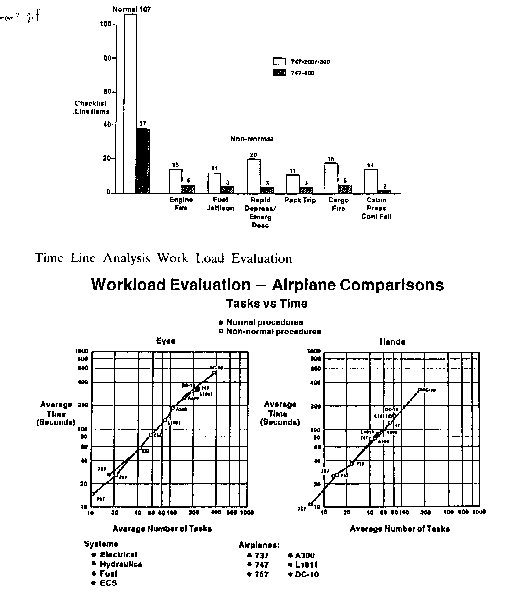
An example of Work Load Evaluation using Eye and Hand Movement Analysis
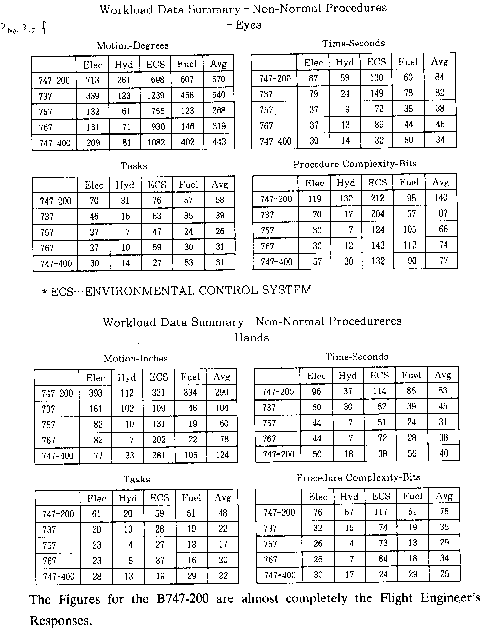
The Figures for the B747-200 are almost completely Flight Engineer’s Responses.
An Example of the PSE Method using Test Pilots Subjective Responses to Questionaires.